
OUR HISTORY
Miller‑Eads Co., Inc. is one of Indianapolis’s premier union electrical contractors, recognized for its longevity, technical excellence, and unwavering commitment to integrity. Founded in 1969, the company’s history is defined by principled leadership, craftsmanship, and long‑term vision. From its wartime roots to its present‑day ownership and leadership, Miller‑Eads has remained steadfast in the values that shaped its founding.
Introduction
Wartime Roots and the
Watson‑Flagg Era
The origins of Miller‑Eads trace back to World War II. In 1941, Watson‑Flagg Engineering Company, a New York–based firm, established operations in Indianapolis at the request of the U.S. Department of War. Watson‑Flagg was engaged to perform electrical work for Curtiss‑Wright Company, a major aircraft engine manufacturer critical to the Allied war effort.
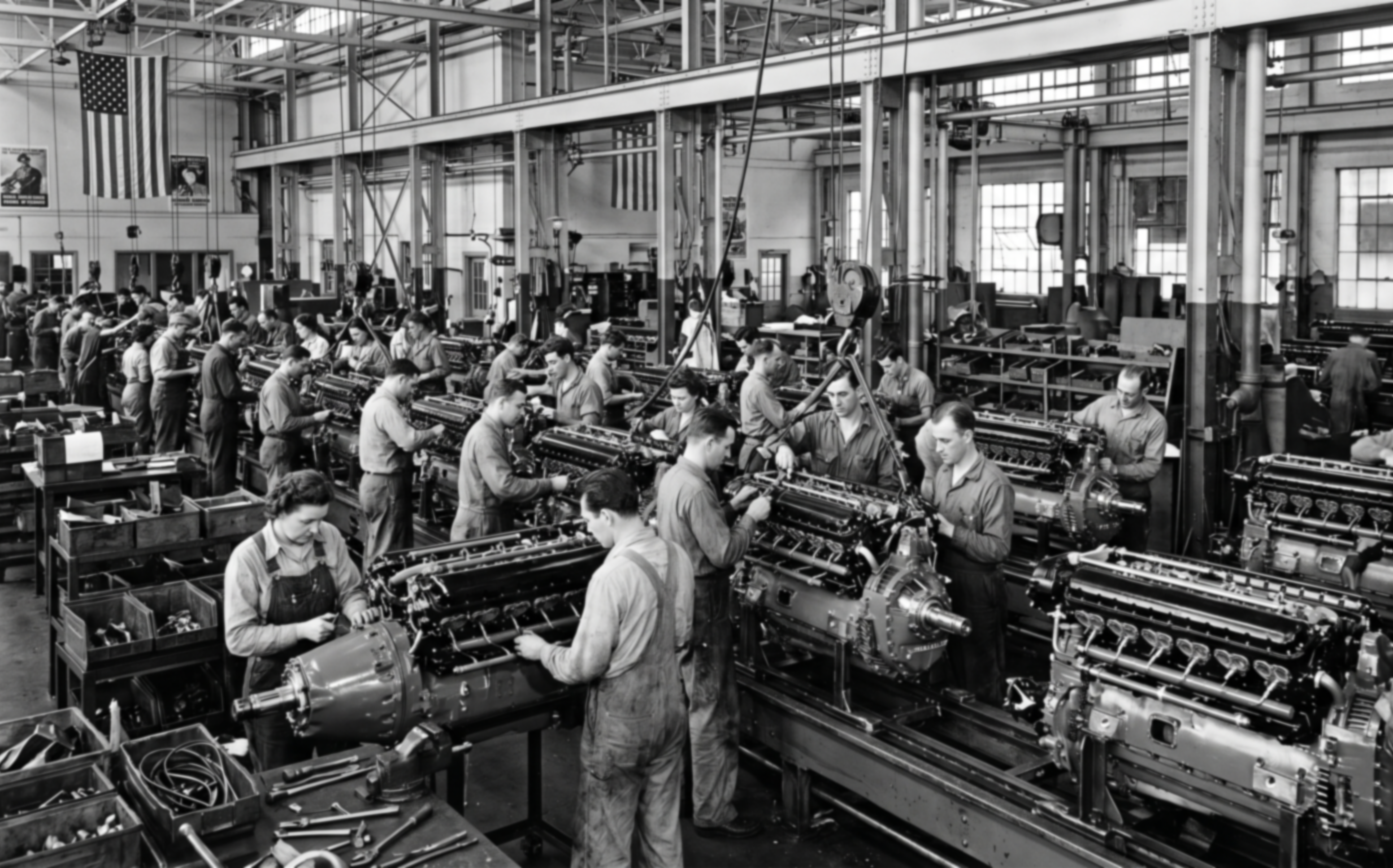
The Indianapolis operation was managed by Ted Johnson, with Ross Miller—a young electrical engineer from Pennsylvania—serving as Project Electrical Engineer. During this period, Watson‑Flagg also participated in highly sensitive projects associated with the Manhattan Project in Oak Ridge, Tennessee, requiring exceptional accuracy, confidentiality, and technical expertise.
After the war, Watson‑Flagg remained in Indianapolis, continuing to support large industrial and commercial projects as the nation entered a period of rapid postwar growth. Ross Miller continued in a leadership role, helping to manage and expand the Indianapolis office.
The Partnership of Ross Miller
and Richard Eads
In the mid‑1950s, Richard “Dick” Eads joined the Watson‑Flagg Indianapolis office as a journeyman electrician. Seeking to advance his career, he began learning estimating and project management under Ross Miller’s mentorship. Over time, their relationship developed into a strong professional partnership.


Throughout the 1950s and 1960s, Ross Miller and Dick Eads became the operational backbone of the Indianapolis office. During periods when ownership leadership was frequently absent, they assumed responsibility for managing projects, developing personnel, and maintaining client trust. Much of Watson‑Flagg’s success during this era was directly attributable to their leadership.
Ross Miller and Dick Eads shared deeply aligned values. Both were thoughtful, fair, intelligent, and ethically grounded. Ross contributed engineering and technical expertise, while Dick provided practical field knowledge and operational insight. Their shared belief that one’s word should be honored became a defining element of their leadership philosophy.
Broken Promises and
a Defining Choice
In 1959, Ted Johnson purchased the Indianapolis office of Watson‑Flagg. Ross Miller and Dick Eads were instrumental in making the purchase possible and were offered company stock, along with assurances that the business would one day become theirs.
Those assurances were broken in the late 1960s when Watson‑Flagg Electric was sold to Fishbach and Moore, a large New York electrical contractor, without the knowledge or consent of Ross Miller or Dick Eads. Faced with this betrayal, the two men were forced to choose between remaining in secure executive roles—Ross as Vice President and Dick as Assistant Vice President—or forging an independent path.
They chose independence.
Founding of Miller‑Eads Co., Inc.
Plans for a new company began around Ross Miller’s kitchen table, reflecting the personal and principled nature of the undertaking. On January 2, 1969, Miller‑Eads Co., Inc. was officially founded.
Entering a competitive market dominated by established contractors carried significant risk. Ross Miller and Dick Eads relied not on corporate backing, but on reputation, technical excellence, and ethical leadership. From the beginning, Miller‑Eads emphasized honesty in estimating, accountability in execution, and respect for employees, clients, and partners.
Growth Through Integrity
Over the decades that followed, Miller‑Eads earned its reputation one project at a time. While many electrical contractors operating during the same era eventually closed their doors—including Watson‑Flagg, which ceased operations in 1986—Miller‑Eads continued to grow steadily.
The company’s sustained success was rooted in culture. Decisions focused on long‑term relationships rather than short‑term gain. Agreements were often sealed with handshakes, reflecting a culture built on trust rather than formality. This approach allowed Miller‑Eads to weather economic cycles while maintaining stability and respect within the industry.
Leadership Continuity and Ownership
Leadership continuity has been a defining strength of Miller‑Eads.

Tom Chastain joined the company in 1978 and became majority stockholder and President in 1990. Under his leadership, Miller‑Eads experienced substantial growth and modernization while remaining grounded in its founding values. Tom retired in 2002, leaving behind a strong and well‑positioned organization.
Dan Sparks, former President of the Indianapolis branch of Watson‑Flagg, joined Miller‑Eads in 1987 as Vice President. His industry expertise and leadership contributed significantly to the company’s continued growth and operational strength. Dan Sparks retired from Miller‑Eads in 2014, concluding a long and impactful career.

Chris Chastain joined Miller‑Eads in February 1990 as an apprentice electrician. He became a journeyman wireman later that year, managed major field projects, and entered the office in 1993 to establish the Service Department. Over time, he led some of the company’s most complex and challenging projects and became President in 2003. In 2014, Chris Chastain became the majority stockholder, and he currently owns 100% of the company stock, ensuring Miller‑Eads remains privately held, locally controlled, and aligned with its founding principles.
Other long‑tenured leaders reinforced this continuity. Greg Costelow joined Miller‑Eads in 1996, became Vice President in 2003, and supported business development and strategic growth until his retirement in 2023.
The Enduring Legacy of the Founders
Ross Miller passed away in 1980, and Richard Eads passed on May 4, 2008. Though no longer present, their influence remains deeply embedded in the company’s culture. Their commitment to honesty, fairness, and accountability continues to guide decision‑making at every level.
A promise was made that the company would always carry their names. That promise stands as a visible reminder of the principles upon which Miller‑Eads was built.